Risk Reward Ratio Trading Explained
Successful market speculation requires a structured framework that prioritizes capital preservation over emotional decision-making. Professional market participants rely heavily on risk reward ratio trading to mathematically validate their positions before risking capital.
By establishing clear target parameters before entering the market, traders can consistently maintain a mathematical advantage over the long term. If you are looking to refine your market strategy and secure institutional capital to scale your performance, partnering with this proprietary futures trading firm provides the institutional framework and advanced resource suite necessary to cultivate sustainable, long-term profitability.
What is Risk Reward Ratio Trading?
Understanding the balance between potential loss and prospective gain is the foundation of any sustainable market strategy.
At its core, risk reward ratio trades are a strategic approach that measures the distance from a trader's entry point to their stop-loss order against the distance from the entry point to their profit target. This relationship dictates how much capital a trader is willing to risk to achieve a specific financial return. For traders who leverage scalable funded accounts to navigate the global financial markets, managing this metric is essential for keeping drawdowns within acceptable operational parameters.
By conceptualizing every trade as a simple mathematical ratio, market participants transition from speculative gambling to systematic capital allocation. The core philosophy behind this trading methodology rests on the realization that winning every single trade is both impossible and unnecessary. Financial markets are inherently unpredictable, governed by a complex web of economic data, geopolitical events, and participant psychology.
Because absolute certainty is unattainable, successful traders focus on managing what they can control, which is the amount of money they stand to lose versus the amount they aim to win.
When a trader consistently risks a smaller amount of capital than they stand to gain, they build a structural cushion into their business model. This structural cushion allows them to withstand consecutive losses without devastating their overall account balance.
In practice, this means analyzing historical price data and order flow to find areas of strong support and resistance. Instead of guessing where prices might turn, traders look for high-probability setups where the distance to the invalidation point is naturally short, while the potential path to the logical target remains unobstructed. Furthermore, this approach provides immense psychological benefits that directly influence execution consistency.
Trading often induces emotional stress, which frequently manifests as early profit-taking or the dangerous practice of averaging down on losing positions. By establishing a fixed risk-to-reward ratio before the market executes an entry order, a trader removes active decision-making during high-stress moments.
The trader knows exactly where the trade invalidates and where it achieves its objective, reducing the urge to interfere with active positions. Over time, this disciplined execution builds confidence, as trading becomes an exercise in probability rather than a series of emotional reactions to temporary market fluctuations.
A trader with a high risk-to-reward setup can thrive even if they lose more than half of their trades, highlighting the supremacy of risk management over simple win rate percentages.

How to Calculate the Risk/Reward Ratio
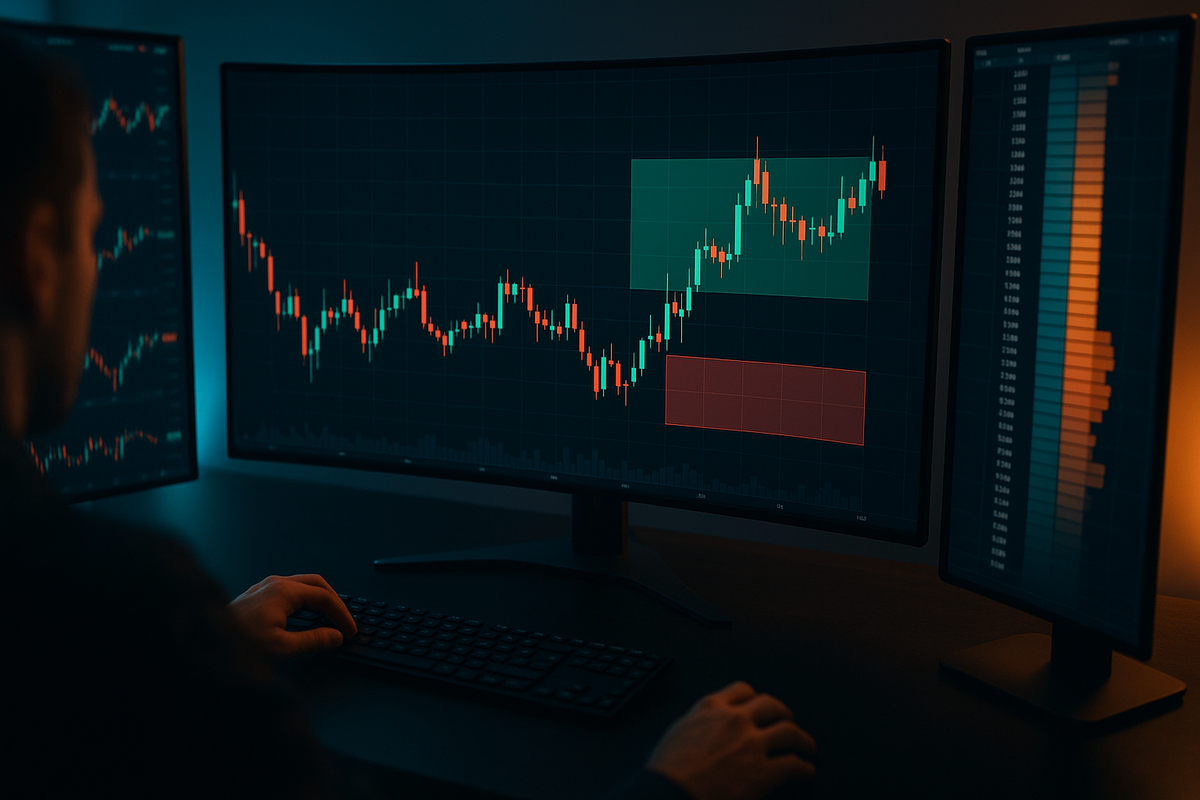
Calculating this fundamental metric is a straightforward mathematical process, but it requires absolute honesty and precision from the operator. To begin the calculation, a trader must identify three specific price levels: the entry price, the stop-loss price, and the profit target price. Adopting a clear trading approach involves establishing these three pillars before committing any capital to the market. The risk is calculated by subtracting the stop-loss price from the entry price, or vice versa for short positions.
Once these two values are established, the trader divides the risk by the reward to obtain the final ratio. For example, if a futures trader decides to buy a contract of E-mini S&P 500 futures at a price of 5,000, they must set clear boundaries. If they place their protective stop-loss order at 4,980, they are risking exactly 20 points on the trade. If they simultaneously place their profit target at 5,060, their potential reward is 60 points. By dividing the risk of 20 points by the potential reward of 60 points, the trader arrives at a risk to reward ratio of 1:3.
This means that for every dollar the trader risks on the position, they stand to make three dollars. To express this as a formal formula, a trader can use: Risk/Reward Ratio = (Entry Price minus Stop-Loss Price) divided by (Take-Profit Price minus Entry Price). When trading assets like foreign exchange or commodities, it is often easier to perform this calculation using pips, ticks, or cents rather than absolute dollar figures.
This standardization makes it highly efficient to compare different setups across various asset classes and timeframes. Regardless of the market traded, the mathematical principle remains entirely unchanged, serving as a reliable universal standard for professional risk assessment. Traders must also factor in transaction costs, commissions, and potential slippage when making these calculations in live market environments.
Slippage occurs when an order is executed at a different price than expected, which can widen the actual risk and reduce the real reward. Neglecting these friction costs can quickly turn a theoretical 1:2 ratio into an actual 1:1.5 ratio, eroding the strategy's overall edge. Therefore, conservative traders always add a small safety buffer to their risk calculations to account for real-world execution variance, ensuring that their planned mathematical edge remains intact under actual market conditions.
What is a Good Risk/Reward Ratio?
Determining what constitutes a favorable ratio depends heavily on a trader's personal style, historical win rate, and specific market focus. There is no single universal ratio that guarantees success, as a higher ratio typically corresponds to a lower win rate, while a lower ratio allows for a much higher win rate. Professional traders utilize structured risk parameters to match their operational metrics with their long-term psychological tolerance levels. For instance, a trader using a highly accurate trend-following strategy might find that a lower ratio is perfectly acceptable because their win rate remains exceptionally high.
Conversely, a breakout trader might require a much higher ratio to offset the frequent small losses associated with false breakouts. To truly evaluate the quality of a ratio, one must analyze it in tandem with historical performance data. "Expectancy" mathematically combines the win rate with the average risk-to-reward ratio to determine if a strategy will generate profits over time. A common mistake among beginners is chasing massive ratios without realizing that the probability of the market reaching those far-off targets is exceptionally low.
A highly realistic ratio that aligns with current market volatility is infinitely superior to an idealistic ratio that is rarely achieved, meaning that market context must always dictate the numbers. By examining historical price charts, traders can observe that markets spend most of their time in consolidation phases, where extreme price extensions are rare.
1:2 vs 1:3 vs 1:5
Comparing these three common configurations reveals the distinct structural trade-offs that traders must manage within their portfolios.
How to Use Risk/Reward Ratios in Your Trading
Implementing a robust system of risk and reward management requires the integration of objective technical analysis with reliable order execution tools. When configuring your workspace on your preferred trading platforms, you should utilize built-in risk measurement tools that automatically project these ratios onto your live charts. Rather than picking arbitrary numbers out of thin air, your entry, stop, and target levels must be derived directly from market structure.
Furthermore, consistent execution requires a deep understanding of position sizing, which dictates how many contracts or shares you should trade based on the distance to your stop-loss. If your stop-loss must be wider to accommodate a major support level, your position size must decrease proportionally to keep your total cash risk identical. This ensures that even though the technical structure of each trade varies, the actual dollar amount risked remains perfectly constant.
By keeping the dollar risk uniform, you allow the mathematical power of your risk-to-reward ratios to work cleanly across a wide distribution of trades. This methodical process removes the guesswork from order management, allowing you to treat each position as a business transaction.
Setting Stop-Loss and Profit Targets
To establish logical market boundaries, a trader must locate key technical areas such as recent swing highs, swing lows, or major volume profile nodes.
Adjusting for Different Market Conditions
Financial markets constantly cycle through different phases, transitioning from high-volatility trends to quiet, low-volatility ranges.

Common Risk/Reward Ratio Trading Mistakes
Even when armed with a solid understanding of mathematical probabilities, many market participants struggle to execute these mathematical risk models effectively due to common cognitive biases and mechanical errors. One of the most prevalent mistakes is setting targets and stop-losses based entirely on desired monetary outcomes rather than technical reality.
For instance, a trader might decide they want to make one thousand dollars on a trade while only risking five hundred dollars, without checking if the market structure supports a move of that magnitude. This arbitrary approach ignores the factual boundaries established by actual buyers and sellers, often resulting in stops that are far too tight or targets that are completely unreachable.
This ensures that their targets are located within logical areas where the market has a demonstrated history of traveling. Another critical error is the habit of manually micro-managing trades once they are active, which completely disrupts the planned ratio. Many traders experience intense anxiety when a position moves slightly into profit, prompting them to close the trade prematurely for a fraction of their planned reward. Conversely, when a trade moves against them, they might move their stop-loss further away in the hope of a market turnaround, which drastically increases their actual risk.
These emotional interventions destroy the statistical mathematical edge of the strategy, transforming a well-planned risk setup into an unpredictable, high-risk gamble. Additionally, many retail traders fail to appreciate how their execution style and platform choice impact their actual ratios.
For example, trading highly volatile index futures during major news releases can result in significant slippage, as tracked and studied by exchanges like the CME Group. When slippage occurs, your order is filled far away from your intended level, which can instantly skew your intended risk profile. Failing to account for these execution anomalies can lead to a scenario where your actual losses are consistently larger than your theoretical model suggests.
Lastly, some traders become overly obsessed with achieving exceptionally high ratios, such as 1:10 or 1:20, without considering the practical trade-offs. While these ratios look highly impressive on paper, they require such precise entries and massive market extensions that they are rarely achieved in live markets.
Successful long-term speculators understand that a modest, consistently achievable ratio is far more valuable than an unrealistic, idealized target that rarely materializes in real-world trading conditions.
Key Takeaways on Risk Reward Ratio Trading
Mastering the direct application of these core principles is a defining characteristic of a professional market participant. This mathematical framework shifts the trader's primary focus away from the futile pursuit of predicting the future, redirecting energy toward the systematic management of risk. By treating each trade as a calculated business risk, operators can insulate themselves from the emotional volatility that typically destroys retail trading accounts.
The ultimate objective is not to achieve a flawless win rate, but to ensure that your winning trades are significantly larger than your losing trades over a statistically significant sample size. To implement this approach successfully, traders must maintain meticulous records of their performance metrics to understand their unique trading profile.
If the data reveals that you consistently exit trades early, you can take active steps to automate your order execution to prevent manual interference. Continuous self-reflection and data-driven adjustments are what separate highly profitable market professionals from perpetual beginners. Ultimately, the key to longevity in the financial markets is consistency and capital preservation.
By strictly adhering to predefined risk parameters, you ensure that you can survive any market regime, whether it is a highly volatile macro event or a prolonged period of low market activity.
FAQs About Risk Reward Ratio Trading
Navigating the practical application of these mathematical principles often leads to several common questions among both novice and experienced market participants. Below, we address some of the most critical inquiries regarding how to integrate, manage, and optimize these parameters to build a highly robust and sustainable business model in the modern financial markets.
What is a good risk/reward ratio for trading?
A highly effective ratio typically starts at 1:2, as this provides a mathematically sound foundation that allows you to remain profitable even with a moderate win rate.
Can you be profitable with a low win rate?
Yes, you can absolutely achieve high profitability with a low win rate if your average winning trades are significantly larger than your average losing trades.
How does the risk/reward ratio affect trading performance?
This essential metric acts as the primary governor of your account equity curve, directly determining how volatile your capital balances will be over time.
Should you use the same risk/reward ratio for every trade?
While consistency is highly valuable in speculative markets, strictly forcing the exact same ratio onto every single trade can be highly counterproductive.
 Kim Tyson